Residue explained
Why would a farmer pay to give straw away?
Straw can have a buyer while the farmer still needs a dependable collection service. Four questions make that arrangement easier to assess.
Educational reading, reviewed 23 Oct 2026. Requirements depend on the applicable methodology and project; this article does not describe CarbonPod’s achieved results or a service offer.
A factory may want straw. A farmer may want a clear field. Between those two needs sits a job someone has to organise.
Loose straw must be gathered, prepared for transport and moved to a place that will accept it. Finding a use for the material does not make that work disappear.
That is why “the straw has value” and “the farmer earns from it” are different statements.
The buyer wants material. The farmer needs a service.
Imagine someone offering to take the straw after harvest, but leaving the collection date open. The offer sounds useful until the next field operation is waiting.
A dependable arrangement answers practical questions: who brings the equipment, who handles loading, when collection finishes, and who pays for each step. Without those answers, a proposed buyer is still only a possibility.
CEEW’s 2024 Punjab report found that some farmers using off-field residue routes paid to have straw cleared, while others gave it away or received payment. That evidence concerns the 2022 kharif season, surveyed in 2023. It is not a price guide for this harvest. CEEW report
The point is not that every farmer pays. It is that clearing the field and selling the material are different parts of the arrangement.
Information has to arrive before the decision
A June 2026 CEEW study adds another piece. In its July–August 2025 survey of 102 farmers across three Punjab districts, 63% said information did not reach them when needed. This was an exploratory, non-representative sample, not a statewide estimate. Study and methods
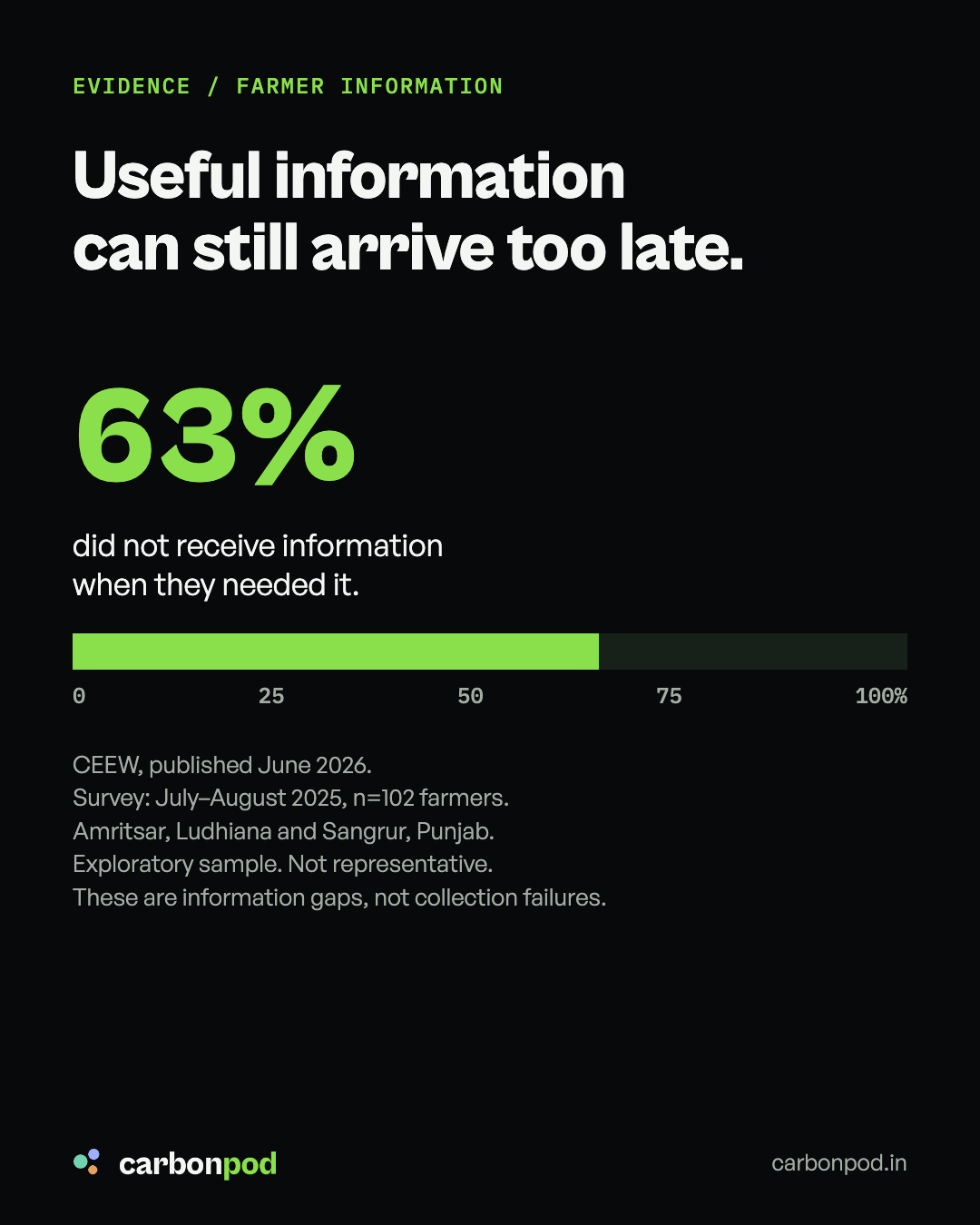
These figures do not measure collection failures or explain what every farmer pays. They show why an announcement alone may leave a practical decision unresolved.
Four questions make an offer more useful
Before agreeing to off-field collection, ask:
- When will it finish? Agree a completion date that fits the next field operation.
- Who does the work? Name the person responsible for machinery, gathering and loading.
- Who pays for what? Separate any payment for straw from collection, loading and transport charges.
- What if collection fails? Agree whom to contact and what happens if equipment or the buyer does not arrive.
This is a conversation guide, not a standard contract. A local agronomist or extension service can also help decide whether residue should remain in the field instead. Removal is not automatically the right route.
CAQM’s May 2026 preparedness review emphasised both in-field management and off-field use, alongside machinery availability. The useful question is which option can actually work in that place and season. CAQM / PIB
Start with the collection promise
Biochar, energy and other uses may create destinations for suitable residue. A destination still needs a workable route from the field.
CarbonPod is developing a model around local collection and biochar. The farmer-facing test comes before the product story: is responsibility clear, is collection dependable, and does the arrangement work for the field?
A use for straw becomes a useful option when someone can reliably do the work.