Air explained
Why does North India’s air turn grey?
Where Delhi’s pollution comes from, why the mix changes with the seasons, and what it takes to make alternatives to crop-residue burning work.
Educational reading, reviewed 10 Oct 2026. Requirements depend on the applicable methodology and project; this article does not describe CarbonPod’s achieved results or a service offer.
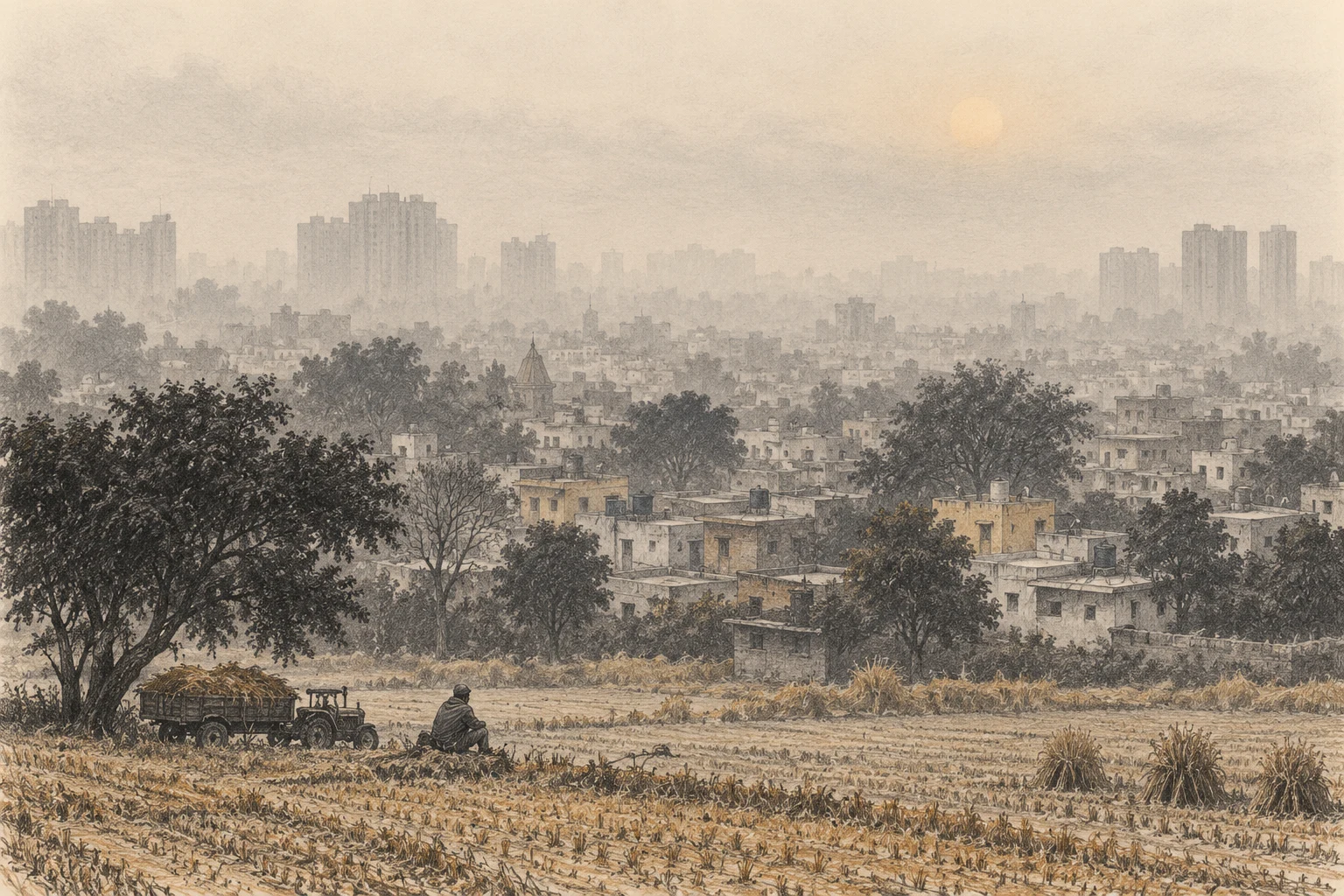
A field outside the city. A busy road. A factory chimney. A pile of rubbish on fire.
They look like separate scenes. In the air, their emissions can become part of the same mixture.
That is what makes Delhi NCR’s pollution difficult to fix. What we breathe depends on what is released nearby, what arrives from elsewhere, and how easily the atmosphere can disperse it.
What is actually in the air?
One major concern is PM2.5, particles small enough to reach deep into the lungs. Exposure contributes to heart and lung disease and other serious health problems. WHO explains the health effects.
Some particles come directly from exhaust, combustion and dust. Others form when gases react in the atmosphere. Those gases can come from transport, industry, power plants and burning.
CAQM’s February 2026 review of studies from 2015 to 2025 provides a useful breakdown for Delhi’s winter air.
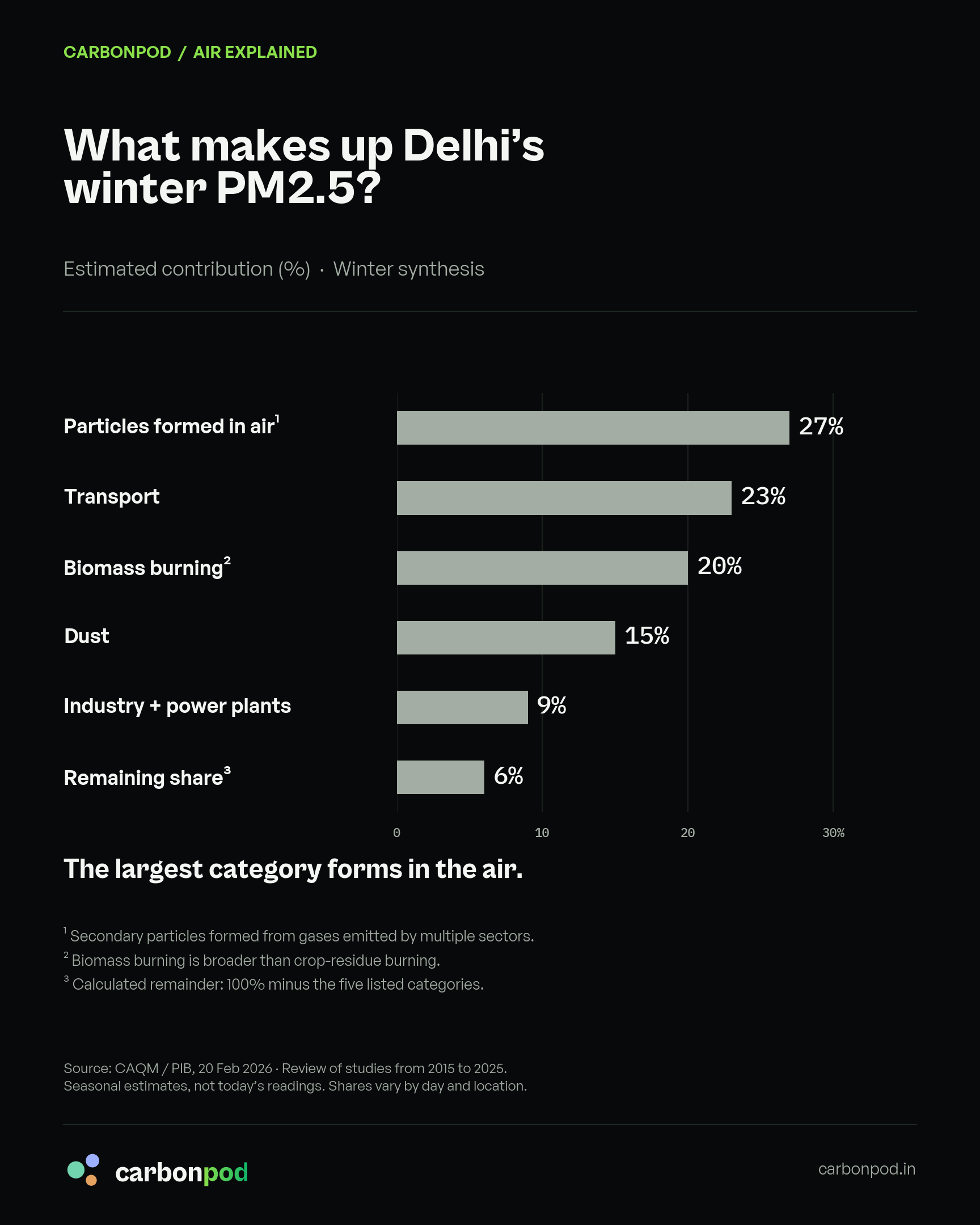
The largest category is particles formed in the air, also called secondary particulates. It is a formation process linked to several emitting sectors, so the chart should not be read as six independent industries. Source: CAQM / PIB, 20 February 2026.
Why does it get worse after the monsoon?
Think of emissions entering a room with poor ventilation.
During stagnant post-monsoon and winter conditions, weak winds and a shallow layer of air available for mixing can keep pollution concentrated near the ground. Humidity and chemical reactions can help more particles form.
A study using observations from Sonipat in October and November 2023 documented this interaction between combustion emissions, pollution arriving from surrounding areas and conditions that trapped it. Read the atmospheric study.
Weather helps explain why a bad day can become much worse. Reducing the emissions entering that air remains essential.
The mix changes through the year
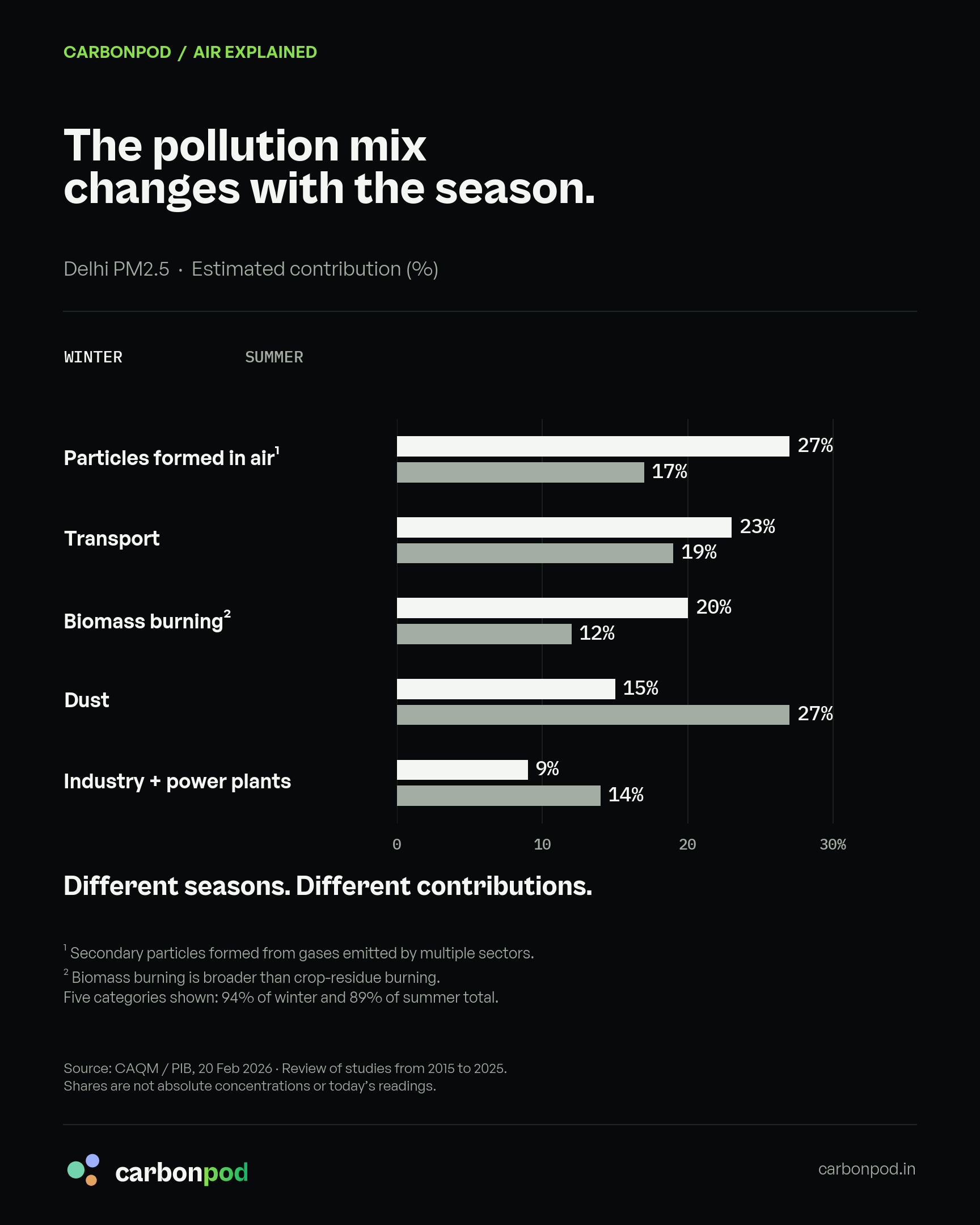
The seasonal comparison below shows why one fixed explanation is insufficient. Dust has a larger share in summer; the shares attributed to biomass burning and secondary particles are larger in winter.
Pollution also travels across city and state boundaries. Delhi sits within the wider Indo-Gangetic Plains air-pollution system, which is why cleaner air requires coordinated action across the region. World Bank: clean air in India.
Where does crop burning fit?
Crop-residue burning can add substantial pollution during post-harvest episodes. Its effect changes with the amount burned, wind direction and atmospheric conditions. Research in northern India has found higher contributions during particular smoke-plume events than across the broader study period. Crop-burning study, 2025.
The chart’s biomass-burning category is broader than crop-residue burning. It would be wrong to label the entire 20% as farm fires.
Avoiding these fires matters. Making that possible requires understanding what happens in the field.
A farmer needs an alternative that arrives on time
After harvest, residue occupies land needed for the next crop. Managing it takes machinery, labour and time, or someone who can collect it and put it to use.
CEEW surveyed 1,478 farmers across 11 Punjab districts in 2023. Among respondents using off-field residue-management methods, 69% gave the residue away, 28% paid to have it cleared, and only 3% received payment. Those figures describe that survey group, not all farmers. CEEW’s 2024 report.
A potential use for straw is only the beginning. A dependable alternative needs collection when the farmer needs it, affordable transport, storage and a reliable destination.
For CarbonPod, that is the part of this larger challenge we want to explore: how suitable surplus residue can reach a useful destination through a system that works for farmers and operators. Our guide to residue collection economics looks at those practical checks.
By the time smoke reaches the city, the decision to burn has already happened. The opportunity is to make another option workable before then.