Residue explained
What can happen to straw instead of burning it?
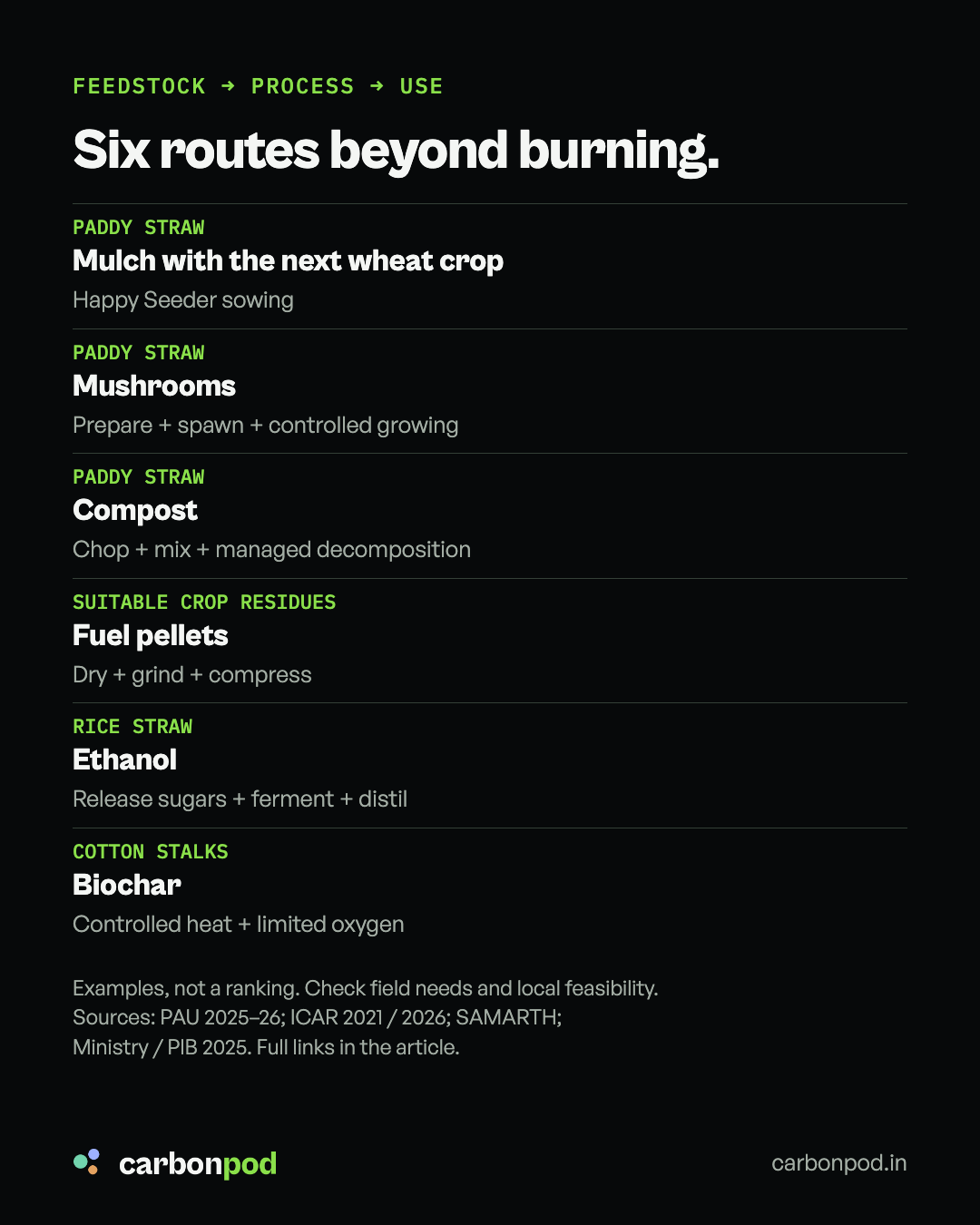
Six concrete examples: mulch, mushrooms, compost, fuel pellets, ethanol and biochar. How each works, and what needs to fit.
Educational reading, reviewed 27 Oct 2026. Requirements depend on the applicable methodology and project; this article does not describe CarbonPod’s achieved results or a service offer.
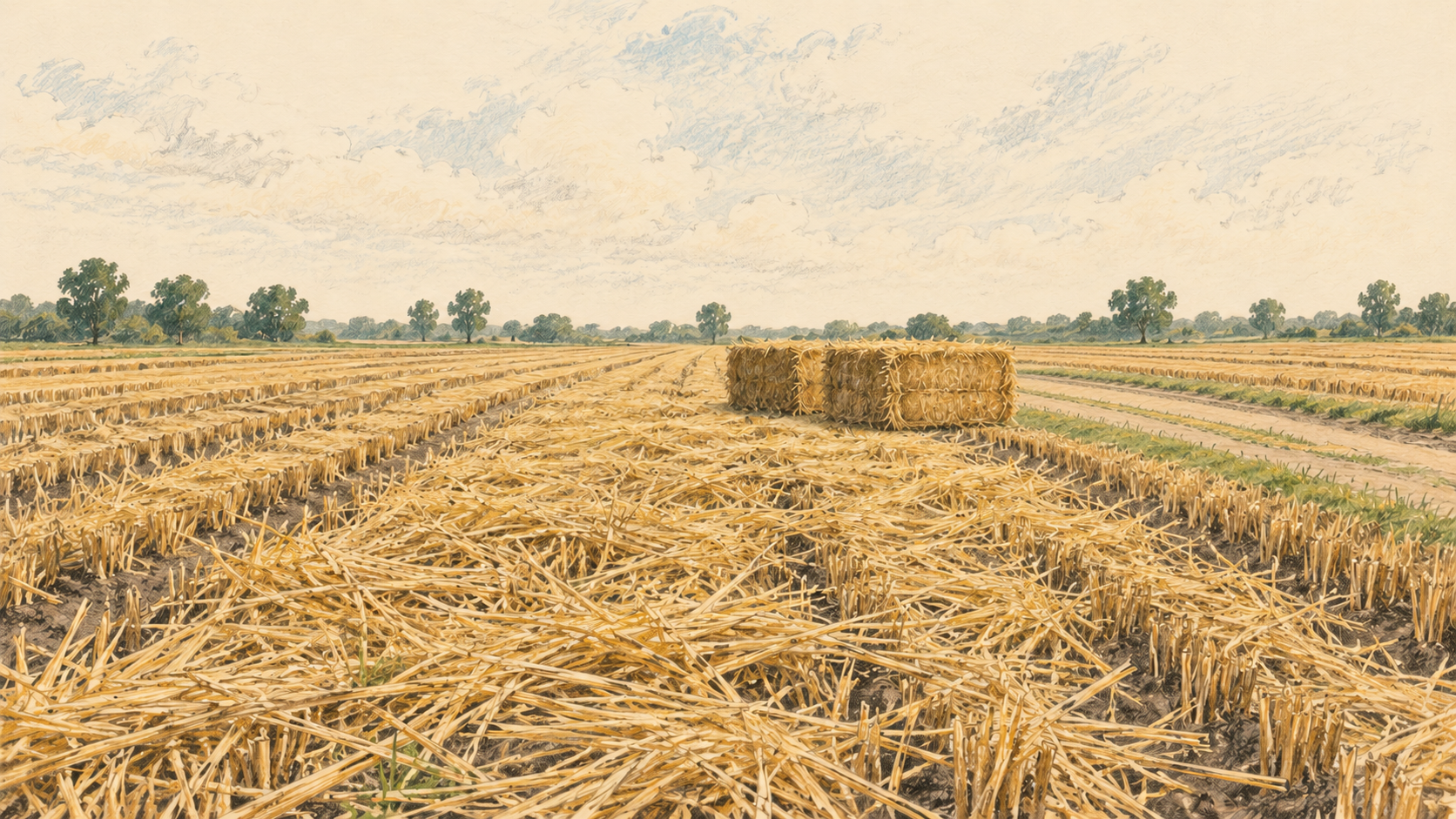
After a rice harvest, a field of straw can become the starting point for the next wheat crop, a mushroom bed or a fuel supply. Cotton stalks can take a different route, including conversion into biochar.
These are real possibilities. But they involve different materials, machines and buyers. Saying “turn waste into value” skips the most useful part: what actually happens to the straw?
Here are six examples, from keeping it in the field to making a new product.
1. Paddy straw can stay while the next wheat crop is sown
Imagine a combine-harvested rice field in Punjab. The next crop is wheat, and loose straw remains on the surface.
A Happy Seeder can sow wheat in that residue. PAU describes how straw should be spread uniformly before sowing. Its upgraded Happy Seeder places chopped straw between the rows as mulch. The farmer is growing the next crop while retaining residue, rather than first collecting every stalk.
The important detail is the sowing system. Straw distribution, soil moisture and machine availability matter. This is not the same as leaving an unmanaged heap and expecting wheat to grow through it. PAU's published Rabi 2025–26 guide gives the technical recommendations; field decisions need locally appropriate advice. PAU package of practices
What it becomes: mulch around the next crop, rather than an off-farm product.
2. Paddy straw can become a bed for mushrooms
Here, the straw provides the material in which the mushroom grows.
A grower prepares suitable straw, introduces mushroom spawn and manages moisture, hygiene and growing conditions. The saleable product is the mushroom. This is a cultivation business, not simply a buyer taking untreated straw from a field.
There is a recent Indian example. In January 2026, ICAR reported growing King Oyster mushrooms on paddy straw under controlled conditions at Basar in Arunachal Pradesh. That demonstrates a specific crop-and-substrate combination. It does not establish that the same mushroom will grow in an open shed through every North Indian season. ICAR, 23 January 2026
What makes it work: a suitable species, good spawn, controlled growing conditions and a market for a perishable crop.
3. Paddy straw can be turned into compost
Composting uses biological decomposition to turn organic material into a soil amendment.
ICAR's technical guide describes chopping paddy straw and combining carbon-rich crop material with nitrogen-richer material such as manure or legume residues. Moisture and management help decomposition. The result is compost, not raw straw that has merely been moved into a pile. ICAR technical guide, 2021
What makes it work: space, other suitable ingredients, moisture and enough processing time. An off-field composting area may accept collected material, but decomposition should not be assumed to fit a short gap between two crops.
4. Crop residues can be compressed into fuel pellets
This route changes the material's form so a suitable energy user can handle it.
The Ministry of Power's SAMARTH guide describes drying biomass, grinding it and pressing it through a pellet mill. Feedstocks include materials such as cotton stalks, maize straw and mustard stalks. A separate Ministry model contract also includes surplus paddy straw among eligible materials. SAMARTH process guide, Ministry model contract, 2022
The pellets are fuel for an accepting user, including suitable thermal power facilities. They are intended to be burned for energy. They are not biochar, and pellet production should not be described as durable carbon storage.
What makes it work: the buyer's fuel specifications, suitable moisture and material quality, processing equipment, storage and dependable delivery. A pellet mill is not a guaranteed market for every residue nearby.
5. Rice straw can be processed into ethanol
At an industrial scale, the plant material can become liquid fuel.
India has a concrete example: IndianOil's second-generation ethanol project at Panipat, Haryana, uses paddy straw as feedstock. The Ministry of Petroleum and Natural Gas confirmed the project had been set up in a December 2025 statement. This is the straw-based 2G project, distinct from the refinery-off-gas 3G plant also mentioned in that statement. Ministry / PIB, 4 December 2025
The process breaks down the straw's plant structure, converts accessible carbohydrates into sugars, then uses fermentation and distillation to make ethanol. A government committee's report on the Panipat unit describes enzymatic hydrolysis, fermentation and distillation. Joint committee report, site visit 26 December 2025
What makes it work: a specialised facility and an organised feedstock supply chain. This example establishes the route, not today's operating rate or an offer to purchase a particular farmer's straw.
6. Cotton stalks can be converted into biochar
Biochar production heats biomass with limited oxygen to make a carbon-rich solid. That differs from composting, which relies on biological decomposition, and from making fuel pellets. ICAR Indian Farming, July 2026
In September 2026, ICAR-CIRCOT discussed cotton-stalk biochar, transport constraints and decentralised conversion. Its scientists also described ongoing research on enriching biochar with banana pseudostem sap and phosphate-solubilising bacteria. Those are specific research directions, not a promise of the same result in every soil. ICAR-CIRCOT, September 2026
What makes it work: a suitable feedstock, controlled conversion, product quality checks and an appropriate end use. Producing a black solid alone does not establish safe agricultural use or verified carbon removal.
The useful question is: which route fits this material, here?
For a rice farmer preparing to sow wheat, retaining straw with suitable machinery may be an option. For a trained mushroom grower, selected straw can be a growing substrate. For a contracted processor, suitable surplus can be a feedstock.
Before arranging collection, establish what should stay in the field and what already has a useful role. Then confirm the destination's acceptance requirements, collection date, delivered cost and responsibility for storage.
CarbonPod is developing a model around local collection and biochar. These same practical questions come first. A useful alternative to burning needs a workable journey from the field to the final use.