Residue explained
The harvest ends. The residue decision begins.
After harvest, farmers need workable choices for residue: suitable machinery, timely collection and a dependable destination.
Educational reading, reviewed 20 Oct 2026. Requirements depend on the applicable methodology and project; this article does not describe CarbonPod’s achieved results or a service offer.
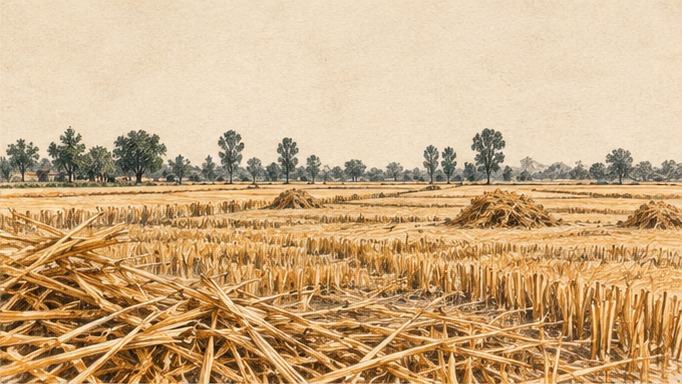
The grain leaves the field. The straw stays behind. For the farmer, the work is not finished.
There is another crop to prepare for, and a decision to make about what remains. Keep it in the field? Arrange machinery to manage it? Find someone who can collect it?
World Food Day, marked on 16 October, was a useful moment to look at this less visible part of producing food. This year's FAO theme is “Innovate today. Nourish tomorrow.” For residue management, a useful innovation has to work within a farmer's calendar. FAO
The next crop sets the deadline
A 2021 CEEW study described a 15–20 day window for clearing paddy residue in Punjab. That is historical, regional context, not a countdown that applies to every farm this season. It illustrates why timing belongs at the centre of the conversation. CEEW's Punjab case study

A proposed use for straw does not answer the farmer's immediate questions. Who will come? When will they arrive? What will the service cost? Will the field be ready for the next operation?
Those are reasonable questions to ask before choosing a different way of managing residue.
Awareness needs practical support
In June 2026, CEEW published research on behaviour change and stubble burning. It drew on a non-representative survey of 102 farmers across four Punjab districts, alongside discussions and consultations. The findings point to financial considerations, mistrust and social norms as well as information gaps. They should not be read as percentages describing all Punjab farmers. CEEW's study announcement
The practical lesson is to ask what makes an alternative usable, rather than assume that another awareness message will settle the decision.
Start with the field, then choose the route
Not all residue needs to leave the farm. In its May 2026 preparedness review, CAQM emphasised both in-field management and off-field use, along with timely machinery availability. CAQM / PIB
A sensible plan starts by checking the crop, field conditions and existing uses. Where residue can be managed appropriately in the field, the question is which method and service will work. Where suitable surplus is collected, the next questions concern transport, storage and a dependable destination.
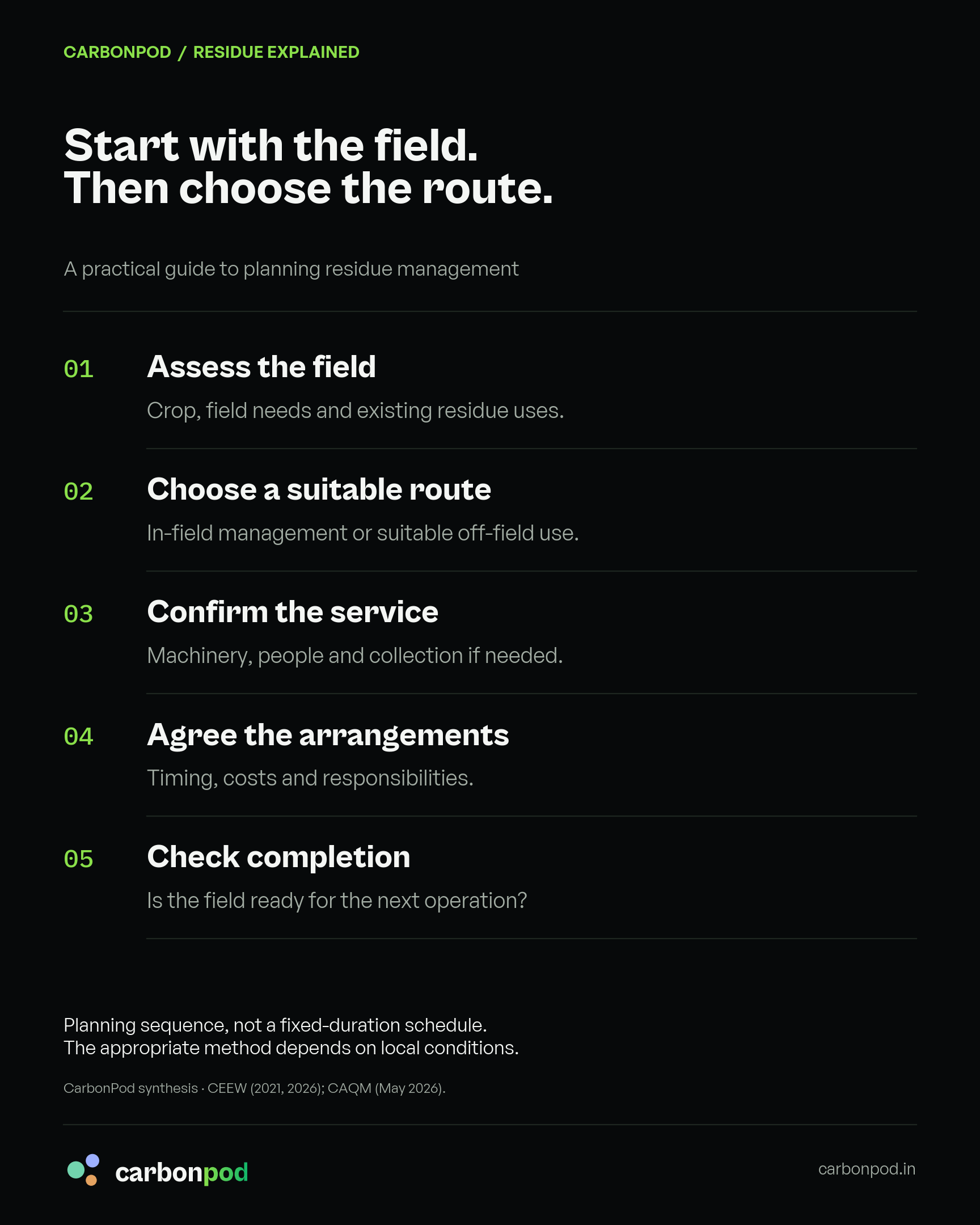
This is a planning guide, not a universal agronomic prescription or a fixed-duration schedule.
A promising product still needs a dependable operation
Biochar is part of this discussion, but it does not remove the need to solve collection and transport. At a September 2026 meeting, ICAR-CIRCOT highlighted raw-material logistics while discussing cotton-stalk biochar. That was a discussion of opportunities and ongoing work, not proof that every residue stream is ready for commercial conversion. ICAR-CIRCOT
CarbonPod is developing a model around local residue collection and biochar. For us, this is where the work begins: understanding suitable surplus, reliable collection and a use that can be supported by evidence. Our residue-collection guide explores those checks.
A useful alternative is one the farmer can actually choose, at the time the field needs it.